English version of the introductory report presented by Vincent Presumey during the videoconference on April 7, 2026.
Follow-up to the meeting and discussion of April 7, 2026, on « military issues. »
With around thirty participants, including several activists responsible for or representing the Fourth International, the RESU (ENSU – European Network for Solidarity with Ukraine), trade unionists, anarchists, and comrades located not only in France but also in Belgium, the United States, Ukraine, and Russia, we held a very productive meeting on April 7. Unfortunately, the recording cannot be shared due to a technical glitch with the video conferencing system.
Following the discussion, we proposed organizing a meeting on May 1 to establish a unified « Forum » addressing this topic. We will provide more details shortly.
That said, this meeting and debate on April 7th, which was of great interest, primarily motivated comrades who were trained and informed on these issues. Our local and union contacts seemed hesitant to engage in such discussions, due to the pressure exerted and ingrained habits that simply silence any expression on this subject, despite its central and urgent nature.
For Aplutsoc, the military issue, while requiring specific consideration, is not a separate domain from the political stakes of the class struggle: for us, it arises in relation to the fight against the far right and the union of the rights in Europe, as a direct expression of the Trump/Putin axis, and therefore in relation to the question of power and unity in order to win in France.
We will therefore continue along these lines. To begin, we are publishing below the notes that served as the basis for the introductory report presented on April 7th.
To introduce “military questions” from the current revolutionary perspective.
1) Seize the present moment.
The Trump-Netanyahu war in Iran
a) is not a repeat of the old Gulf Wars of 1991 and 2003,
b) is not directed against the mullahs’ regime but is a continuation of the January 2026 repression, a terrible repression whose scale is comparable to that of the Paris Commune,
c) and falls within the framework of imperialist multipolarity, combining coexistence and rivalry, with the United States extending a hand to Russia, which, along with China, simultaneously stands behind Iran.
However, this Trump-Netanyahu war is failing. These notes were written on the day Trump threatened to “destroy a civilization,” and therefore the day before his retreat, effectively conceding control of the Strait of Hormuz to Iran.
It is failing on all fronts, not in the sense that the Iranian regime or some other “axis of resistance” is gaining a military advantage, but in the sense that, conceived as the epicenter of Trump’s internal/external escalation (ICE, Greenland, etc.), it is bringing the crisis of US presidential power to a fever pitch. This power is immediately confronted with the dilemma of rapid collapse or an authoritarian coup (with J.D. Vance’s provisional solution).
In recent days, we have witnessed Trump’s delusional pronouncements, the leaks, the dismissal of Pam Bondi and Kristi Noem, the purge in the military (affecting the Chief of Staff of the Army, the Chief of Training and Technological Development, and the Chief Chaplain!), and so on.
This fiasco could also lead to a further escalation, dubbed « hellfire »—a nuclear strike?—to reignite the shock. This would be a far worse repeat of the initial « successful blow » (Khamenei’s death), what war historians call a « catastrophic success » of the Pearl Harbor type for Japan. But the catastrophe for Japan came four years later, and here it would be a matter of days, even hours, not to mention minutes… Note: since April 8, this possibility seems to have been temporarily ruled out.
If you want to see what prevents us from truly grasping the present moment, then look at the Porto Alegre conference declaration: generalities conflating imperialism, capitalism, fascism, and neo-liberalism, in a worldview identical to that of the temporary imperialist unipolarity of the first Gulf War (1991), clinging to the almost singular American imperialism, without even grasping the specificity of the Trump moment, and implicitly conflating democracy and capitalism, and therefore fascism.
Such theoretical, moral, and intellectual disarmament leads directly, at best, to defeat, at worst, to rapprochements with certain contemporary forms of fascism!
2) Fascism?
We have generally rejected sociological discourses on “ambient,” or creeping, fascism, or the “fascization of society.” The question of fascism should not be posed in general terms or in relation to all of society, but rather in the context of the global political situation and the present moment.
Therefore, it is now necessary to characterize as “fascism” the orientation of imperialist/oligarchic capital, which, moreover, openly refers to historical fascism and Nazism: see the Nazi salutes of Musk, Bannon, etc., but which are not repetitions! These salutes mean: we embrace this legacy, but we will do it bigger, faster, stronger!
The greatest difficulty for contemporary Fascism 2.0 is to indoctrinate large masses: it is first and foremost oligarchic—Silicon Valley! —and state-based—in this respect, Putin is the model.
Certain religious mass bases (Islamism and Evangelicalism in particular) provide him with his largest reservoirs of popular support, and Trumpism, like Bolsonaroism, carries this danger. However, large-scale mass mobilizations of a national-democratic character in the United States are, by far, the No Kings movement, which is a central factor in the global balance of power between classes.
ICE has recruited the equivalent of fascist militias, but the MAGA crisis, which reflects and amplifies the crisis of the US presidential institution, is seeing the development of a MAGA wing that is at odds with Trump, anti-Semitic, pacifist abroad (isolationist), and increasingly less under control.
If we are dealing with 21st-century fascism in its various forms, primarily those of Trump and Putin, but also Netanyahu, Khamenei and his successors, Milei, and potentially Xi and Modi—that’s quite a lot! – So that means we’re going to have to fight, in the military sense of the term.
Not only does « the left » not realize this, but it also doesn’t realize that it began in Ukraine on a mass scale in 2022 (and had been brewing since 2014)!
The question of an anti-fascist people’s war is an immediate issue and one that will grow.
We have the national-democratic war of the Ukrainians, which also clashes with the pro-bosses policies of their government. The contradiction is that the same person, Zelensky, is both the national leader and the head of this government that is sabotaging the people’s war, and this contradiction is concentrated within the national army.
This was evident in Syria, but the hijacking of the uprising that toppled Bashar al-Assad by HTS has since developed its brutal counter-revolutionary effects.
This certainly applies to Myanmar, which warrants further study, as well as to Sudan, where the two military factions have dispossessed the unarmed masses of their struggle.
The tragedy of the Palestinians, paving the way for their genocidal destruction, is that the national-democratic people’s war should and could be theirs, but it has been confiscated by Hamas and the « axis of resistance, » compounded by the corruption and paralysis of Fatah, and further guaranteed by the slow assassination in prison of Marwan Barghouti. Hamas and the « axis of resistance » are not the representatives, but rather those who prohibit popular self-defense. This is done with the de facto political support of the predominantly pro-Palestinian and anti-Zionist movement » worldwide, a movement that has thus contributed to the deadly defeats of the Palestinian people. Here we have – alas – the antithesis of a true people’s war, the kind of war that the Ukrainian people have begun to design.
3) Inflected by fascism 2.0, the global class struggle makes Europe a central battleground.
The European continent, with Ukraine and Palestine forming its gateways, is targeted by Trump and Putin for two reasons:
a) Capitalism in crisis must destroy the democratic and social achievements of which this continent is historically the heartland (due to its having been the cradle of capitalism),
b) European imperialisms (including Canada, Japan, and Australia) must be brought to heel.
These two objectives are distinct and, for us, must be clearly differentiated: we are not defending the French overseas territories, nor the institutions of the European Union and the Eurozone, but we are indeed defending Europe.
For Trump and Putin, the European question is central, and this is reflected in the « anti-European » rhetoric of many groups, and in the theory that the primary cause of war is European militarism, which is false.
This does not mean that militarism does not exist, particularly among European powers (France, the United Kingdom, and Germany), rather than being purely « European, » but rather that the main threat of war, combined with the threat of the far right and the alliance of right-wing parties, is being waged against Europe and within it by American and Russian imperialism.
It is therefore crucial to understand, when examining the question of « war » in the world today, that while there is certainly no threat of « war » as an abstract and malevolent fetish, in the sense often used by pacifists, there is rather a plurality of concrete wars, each requiring concrete examination and specific stances—but this is not simply an incoherent list of scattered wars. Currently, wars are organized along an axis in which American and Russian imperialism, amplified by the far right, threaten Europe politically, economically, culturally, and militarily.
For social movements in Europe and America, this question is therefore central. Furthermore, if the Trump/Putin axis, whose orientations are best expressed in the speeches of J.D. Vance, were to succeed in crushing Europe, then the risk of world war, undoubtedly between the United States and China, would come to the fore: a global inter-imperialist war, with its terrifying destructive potential, requires certain conditions, which essentially consist of proletarian and democratic defeats. And this again brings us back to Europe, not through Eurocentrism, but through an understanding of real global dynamics. And this has become rapidly clear since the beginning of 2026.
First, the breakup of Greenland has placed the prospect of war between European imperialisms and the United States on the horizon, while Russian imperialism continues its war against Ukraine, its « hybrid » war against the continent, and its threats to the Baltic Sea, combined with those of Trump (with Denmark caught in the middle!).
Secondly, the war against Iran does not reduce the rift between the United States and Europe but widens it: the French government, following the Spanish example, is now quick to claim that this war is not its own.
European capitalist/imperialist governments are bewildered and are not resolutely confronting this situation, even though they are being pressured to do so.
Therefore, NATO, as a US-led alliance, is virtually nonexistent: Macron, Starmer, and Merz know this but refuse to acknowledge it. For them, facing the question of NATO head-on would mean considering expelling the United States (and integrating Ukraine), thus transforming it into something entirely different. They are incapable of doing so and do not want to, but it is worth noting that they are aided in this by the repetition of the old left-wing slogan denouncing their « Atlanticism » and calling only for « leaving NATO, » while refusing to engage with these real contradictions of the present moment.
A valuable point in LM’s article, « For a Workers’ Military Policy« , is that it emphasizes that, contrary to what Macron and the « pacifist left » would have us believe, there is no war economy in France, nor a war budget. There is, however, a capitalist economy and budget to satisfy the industrial and financial arms trusts and their export projects, historically symbolized by the Rafale fighter jet: this is not the same thing. The workers’ military policy we advocate opposes this kind of militarism. Thus, spending is directed not toward popular self-defense and its means, including offensive ones—everyone talks about drones, but only the Ukrainians, the Ukrainian people, manufacture them en masse!—but toward nuclear weapons, which are not weapons, but pure forces of global destruction.
The fight against Macron, Merz, Starmer, as well as against Meloni, and the criticism of Sanchez, cannot therefore consist of accusing them of being European warmongers and Atlanticists pushing for world war. This discourse, echoed in the workers’ movement by Stalinism and its supposedly « Trotskyist » agencies like the POI, and feeding on the peaceful sentiments of the masses, is that of a sacred union directed towards Putin and Trump.
On the contrary, the subjugation of Europe means the far right or the union of the right in power, with France and the French Fifth Republic as the key country.
Blocking the National Rally and the union of the right is a prerequisite for the popular defense of Europe against Trump and Putin. And conversely: this means that pacifist and anti-European rhetoric is a direct obstacle, on the national stage, to achieving unity and victory against the National Rally and the alliance of the right, and against Macron and the Fifth Republic.
Furthermore, the policy of subjugating Europe, shared by Trump and Putin, allows Trump and the United States to pursue their policy of total subjugation of the Americas, which entails bringing Brazil, Mexico, and Canada to heel (the latter being directly threatened with secession by Alberta and military encirclement by Greenland).
The direction of the Porto Alegre conference, which completely ignores the question of Europe—which, in the eyes of the campists, must forever remain an appendage of Washington—is therefore directly counterproductive from a Latin American perspective. This situation inevitably leads to contradictions, particularly in Brazil, within the government and the Workers’ Party (PT): initially oriented towards Putin and the BRICS, Lula is being driven by the intense pressure from Trump, especially since the latter’s intervention in Venezuela, to orient « multipolarity » also, or even primarily, towards Europe (he even places the Mercosur/EU trade agreements within this framework).
To conclude this point: the defense of Europe—not of its governments, nor of EU institutions, but rather of the European peoples and the continent’s social, democratic, and cultural achievements—must be at the heart of any serious internationalist revolutionary movement.
This leads to a large-scale discussion of the means of its military defense, coupled with the imposition of unity to win, to immediately oust Meloni and Orban, and to force unity in France to block the National Rally and the alliance of the right wing from coming to power, thereby initiating the democratic dismantling of the Fifth Republic.
The two aspects—military preparation and unity to win—are linked, and it is through this connection that the military question can be popularized, because, linked to the fight for unity, it addresses the needs of the masses.
4) On purely military matters
Regarding weaponry, we must move beyond the pacifist/“job protection and public sector” dichotomy typical of the [French] CGT (General Confederation of Labour), and demand the expropriation, under social control, of arms trusts to massively redirect their production towards anti-drone drones and portable directional anti-drone jammers, machine guns and mobile anti-drone firing platforms, light personal weapons and body armor, nuclear-biological-chemical (NBC) protective masks and suits, light transport vehicles and infantry fighting vehicles (IFVs)…
Regarding mobilization, neither the pseudo-voluntary conscription launched by Macron, nor the SNU (National Universal Service) conceived in terms of bringing youth to heel, should be supported: we must get rid of them and move towards the massive association of the population, through democratic and trade union structures, with an army that merges with the social body. In public education, this implies, on the one hand, rejecting outdated forms of regimentation and militarism, and on the other hand, organizing, at the end of high school, an open, co-educational military training program, integrated with the teaching and discussion of military history and the humanities, in a pluralistic, democratic, and humanistic manner. What needs to be defined is therefore neither an isolated professional army nor a new, outdated universal military service, but a new army, as Jaurès put it, democratically integrated with the entire social body.
Nuclear “deterrence” is not part of democratic and working-class military policy. Its use would be counterproductive and dangerous for the state employing it. Its cost is enormous and lies at the heart of the imperialist financial economy. These funds must be used for genuine social and popular self-defense. The existence of nuclear stockpiles, which—like nuclear power plants—cannot be instantly eliminated, is neither aid to peoples directly threatened by Trump and Putin, nor an effective means of defense and counterattack; at most, the question of « tactical » nuclear weapons (quotation marks are necessary) is debatable in relation to nuclear bases and missiles identified as such. It is therefore necessary to halt the increase in nuclear spending and to open up the management of existing stockpiles to democratic debate.
Note: the three points above are not a take-it-or-leave-it « program, » but rather open avenues for discussion. This discussion, in itself, and its promotion, are a means of moving forward.
5) In conclusion
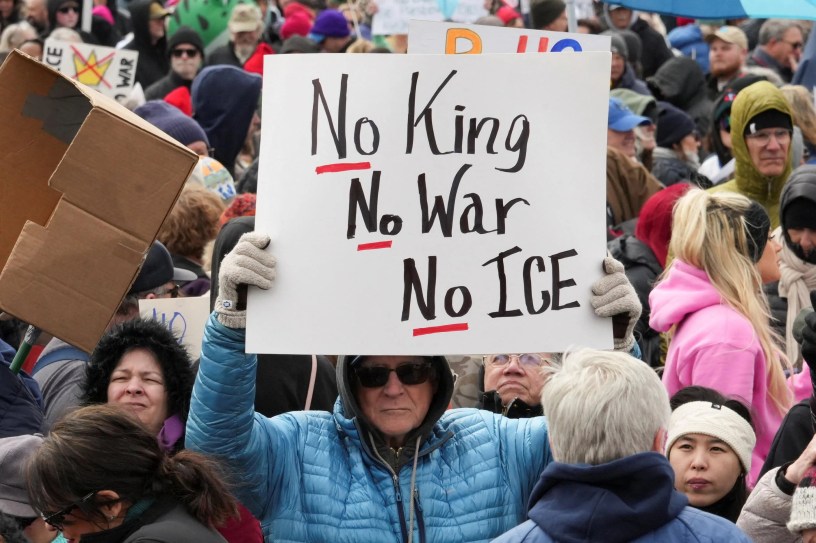
Let us be cautiously optimistic. The general public, as seen in the United States with the No Kings movement and with the mobilizations of Gen Z worldwide, grasps the issues discussed here empirically and intuitively far better than the activist groups subjected to an ideological conditioning by which the dead seize the living. They are peaceful in the sense that they prefer peace, and rightly so, but consequently they despise oppressive victors and global dictatorial buffoons. The photo illustrating this article shows the most popular sign in the United States recently: « No Kings, No ICE, No War. » There is no contradiction here: the fight against the oligarchy, the dictatorship, ICE, and Trump’s wars is the foundation of any real preparation for the social and civil wars that are coming and will emerge within, through, from, and against the current wars.
The true tradition of revolutionary socialism regarding war and the military is not pacifist, but entirely pragmatic: the transformation of imperialist war into civil war is the quintessential expression of this pragmatism. Depending on the war, one must be belligerent, defensive, pacifist, or defeatist, but with a common thread: we want power, therefore we want weapons!
The activist who plays the « full-throttle class struggle » card while forbidding war and therefore weapons is, by definition, a revolutionary without a revolution.
There is a global unity of class struggle and the coming war, without precise borders. Preparation for war begins with unity to block the path of the National Rally, even if many activists don’t understand this. Let us hasten, calmly, to foster understanding.
 Arguments pour la lutte sociale